Introduction
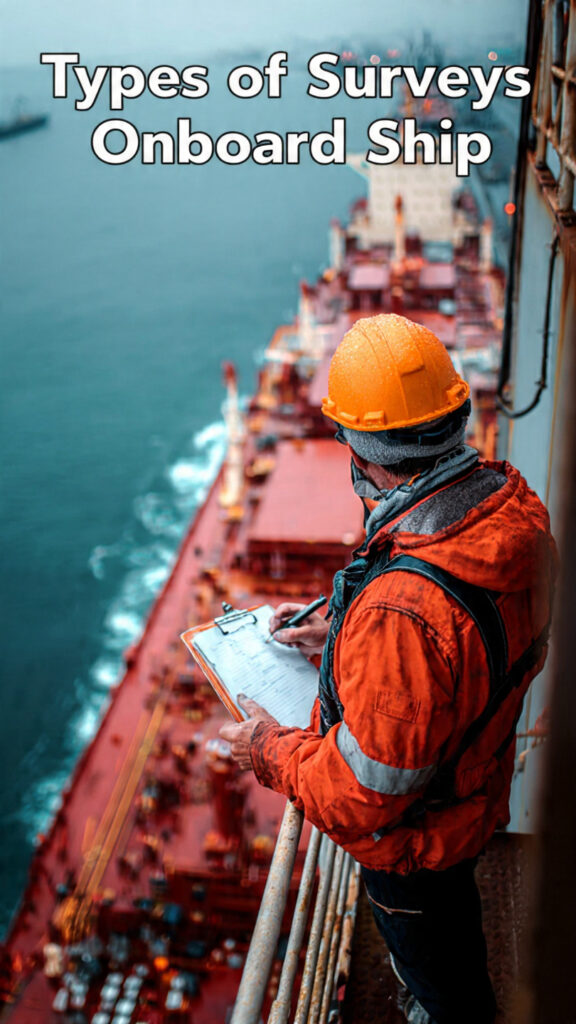
The types of surveys onboard ship play a crucial role in ensuring the safety, efficiency, and compliance of every vessel at sea. These surveys are mandatory under international conventions such as SOLAS, MARPOL, and the Load Line Convention. Conducted by the Flag State or a Recognized Organization (RO), each survey verifies that the ship and its equipment meet required safety and environmental standards.
Therefore, understanding the different types of surveys onboard is essential for every seafarer and ship operator.
Purpose of Ship Surveys
The main goal of conducting ship surveys is to ensure that the vessel remains seaworthy throughout its service life. Surveys help identify potential hazards, equipment failures, or structural issues before they cause accidents. In addition, they confirm that the ship complies with international maritime conventions and national regulations.
By maintaining regular surveys, shipowners also prevent detentions during Port State Control inspections.
Classification of Surveys Under HSSC
The Harmonized System of Survey and Certification (HSSC) standardizes survey schedules across various IMO conventions. Under HSSC, surveys are harmonized so that all certificates can be renewed simultaneously.
The major types of surveys onboard ship include:
- Initial Survey
- Annual Survey
- Intermediate Survey
- Renewal Survey
- Additional Survey
Let’s understand each one in detail.
1. Initial Survey
The Initial Survey is the very first inspection conducted before a vessel enters service. It ensures that the ship has been constructed, equipped, and documented in full compliance with relevant conventions such as SOLAS, MARPOL, and the Load Line Convention.
Surveyors check the hull, machinery, safety systems, pollution prevention equipment, and documentation. Once the vessel meets all requirements, statutory certificates are issued.
In short, the initial survey certifies that the ship is safe and ready for operation.
2. Annual Survey
The Annual Survey takes place every year within three months before or after the anniversary date of the ship’s certificate.
Its purpose is to confirm that the ship, its equipment, and systems remain in satisfactory condition. Surveyors examine safety appliances, navigation equipment, machinery, and pollution prevention systems.
During this survey, minor defects are identified and corrected immediately. If major issues are found, the ship may undergo an additional inspection. Regular annual surveys help maintain the vessel’s continuous compliance with IMO standards.
3. Intermediate Survey
The Intermediate Survey occurs between the second and third anniversary dates of the ship’s certificates. It is more detailed than the annual survey but less extensive than the renewal one.
Surveyors inspect the structural integrity, safety construction, and machinery systems to ensure the vessel remains safe for operation.
In some cases, this survey combines elements of both the annual and renewal inspections. Consequently, it ensures that the ship’s condition does not deteriorate over time.
4. Renewal Survey
The Renewal Survey, also known as the Special Survey, is carried out at five-year intervals before reissuing certificates.
It is the most comprehensive of all surveys. Surveyors conduct a complete examination of the ship’s structure, machinery, safety systems, and pollution prevention equipment.
The ship may need to be dry-docked so that underwater parts like the hull, propeller, and rudder can be inspected thoroughly. Once completed successfully, a new set of statutory certificates is issued under HSSC.
Therefore, this survey effectively “resets” the vessel’s certification cycle.
5. Additional Survey
An Additional Survey takes place whenever a significant modification, damage, or repair affects the ship’s safety or environmental compliance. For example, after a collision, fire, or machinery failure, surveyors perform an additional inspection to ensure the vessel’s condition remains acceptable.
Furthermore, an additional survey may also be conducted to verify corrective actions after deficiencies have been found during Port State Control inspections. This type of survey helps maintain confidence in the vessel’s operational safety.
Importance of Regular Surveys
Regular surveys onboard ships ensure:
- Safety at sea by detecting potential risks early.
- Environmental protection by verifying compliance with pollution control measures.
- Operational reliability through continuous monitoring of machinery and systems.
- Legal compliance with IMO and flag state requirements.
- Reduced downtime since surveys prevent unexpected detentions or delays.
Therefore, consistent and timely surveys are vital for the smooth functioning and reputation of any ship.
Conclusion
In conclusion, the various types of surveys onboard ship—Initial, Annual, Intermediate, Renewal, and Additional—form the backbone of maritime safety and environmental compliance. Together, they ensure that every vessel sailing across the oceans remains seaworthy, safe, and environmentally responsible.
By understanding these survey types, seafarers can contribute to efficient ship management and uphold the principles of the Harmonized System of Survey and Certification (HSSC).
Disclaimer:This article is for educational purposes only. For official requirements, refer to the latest IMO conventions and flag state regulations.