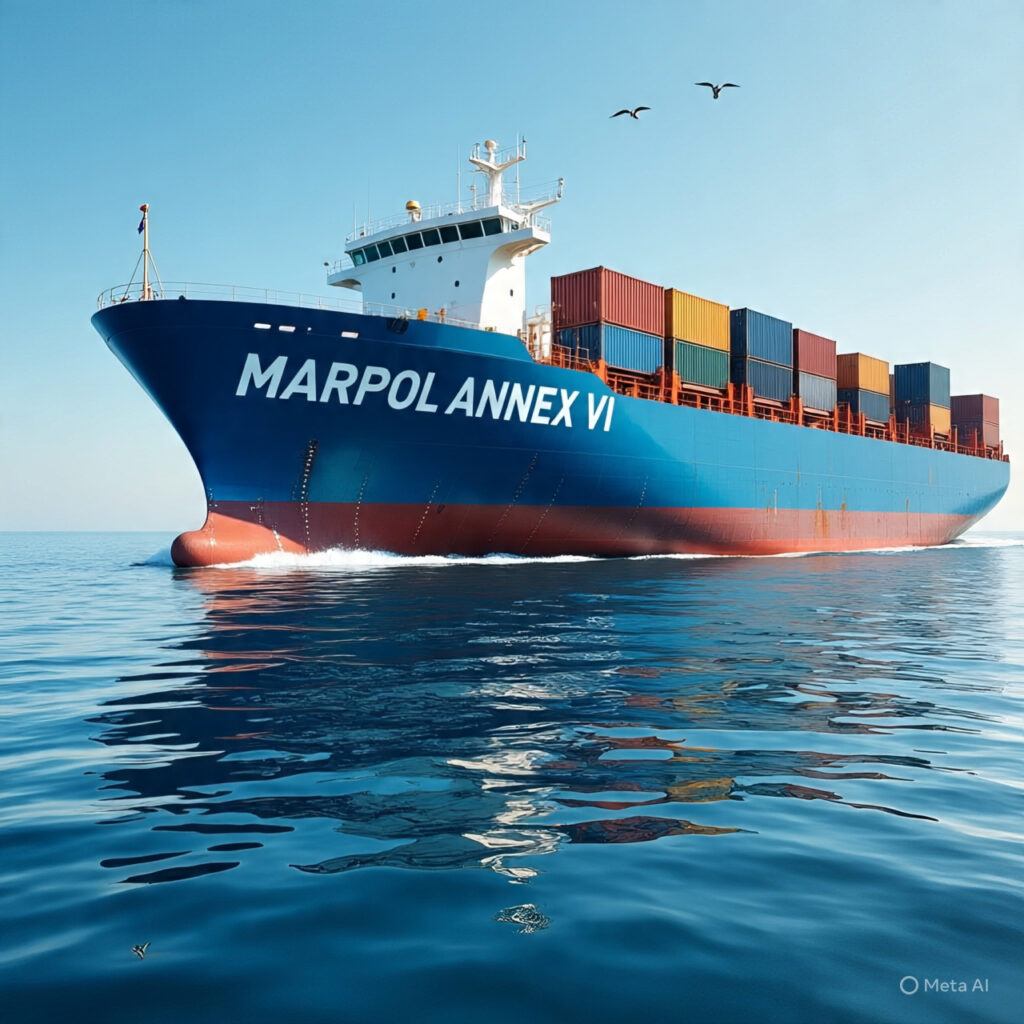
The International Convention for the Prevention of Pollution from Ships (MARPOL 73/78) serves as the cornerstone of international maritime environmental law. Among its six annexes, MARPOL Annex VI focuses on the Prevention of Air Pollution from Ships. This annex entered into force on 19 May 2005 and has since undergone several significant amendments to address both air pollution and greenhouse gas (GHG) emissions from the shipping industry.
Objective of MARPOL Annex VI
The main goal of MARPOL Annex VI is to reduce air pollution from ships that contributes to global warming, acid rain, and health problems. The annex sets limits on emissions of sulfur oxides (SOx), nitrogen oxides (NOx), particulate matter (PM), and volatile organic compounds (VOCs). Additionally, it introduces measures to improve energy efficiency and limit greenhouse gas emissions.
Applicability of MARPOL Annex VI
MARPOL Annex VI applies to all ships engaged in international voyages. It covers:
- Cargo ships,
- Tankers,
- Passenger vessels,
- Offshore platforms, and
- Any other ship type, regardless of tonnage.
Therefore, every vessel must comply with fuel, emission, and efficiency requirements under Annex VI.
Key Regulations under MARPOL Annex VI
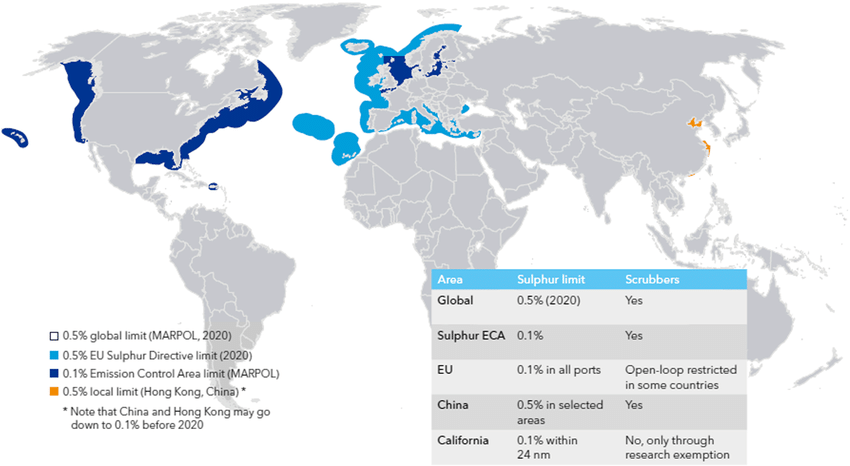
MARPOL Annex VI establishes several important regulatory measures.
1. Sulfur Oxide (SOx) Emission Limits
Ships must use compliant fuel or adopt alternative technologies to reduce sulfur emissions.
| Area | SOx Limit | Effective Date |
|---|---|---|
| Global | 0.50% m/m | From 1 Jan 2020 |
| ECAs (SOx) | 0.10% m/m | From 1 Jan 2015 |
2. Nitrogen Oxide (NOx) Controls
NOx limits depend on the Tier level and whether the ship operates inside a NOx ECA (NECA).
| Tier | Applies to Ships Constructed On/After | g/kWh (n = engine speed) | Applies in Areas |
|---|---|---|---|
| Tier I | 1 Jan 2000 | 17.0 (n < 130 rpm), 45·n^(-0.2) (130–2000 rpm) | Global |
| Tier II | 1 Jan 2011 | 14.4 (n < 130 rpm), 44·n^(-0.23) (130–2000 rpm) | Global |
| Tier III | 1 Jan 2016 | 3.4 (n < 130 rpm), 9·n^(-0.2) (130–2000 rpm) | NECAs only |
(n = engine speed in rpm)
3. Energy Efficiency Requirements
- The Energy Efficiency Design Index (EEDI) ensures new ships are more fuel-efficient.
- The Ship Energy Efficiency Management Plan (SEEMP) requires all ships to adopt efficiency strategies.
- The Carbon Intensity Indicator (CII), introduced in 2023, measures ship efficiency annually and assigns grades.
4. Ozone-Depleting Substances (ODS)
Annex VI bans deliberate emissions of ozone-depleting substances such as CFCs and halons.
5. Volatile Organic Compounds (VOCs)
Tankers must use approved recovery systems to reduce VOC emissions during cargo handling.
Special Areas under MARPOL Annex VI (ECAs & NECAs)
Annex VI designates Emission Control Areas (ECAs) and Nitrogen Emission Control Areas (NECAs) as special zones where stricter standards apply.
Designated ECAs/NECAs:
- Baltic Sea Area – SOx & NOx ECA/NECA
- North Sea Area – SOx & NOx ECA/NECA
- North American Area – SOx & NOx ECA/NECA
- United States Caribbean Sea Area – SOx & NOx ECA/NECA
Within these areas:
- Sulfur content of fuel oil must not exceed 0.10%.
- NOx Tier III standards apply to new marine diesel engines.
Enforcement and Compliance
Compliance with MARPOL Annex VI is ensured through:
- Fuel sampling and testing by port state authorities.
- International Air Pollution Prevention (IAPP) Certificate, issued after inspections.
- Verification of Bunker Delivery Notes (BDNs) and Fuel Oil Non-Availability Reports (FONARs).
Non-compliance can result in heavy fines, vessel detention, or denial of port entry.
Importance of MARPOL Annex VI
MARPOL Annex VI plays a critical role because it:
- Reduces harmful sulfur and nitrogen emissions, improving air quality.
- Prevents acid rain, which damages forests, crops, and lakes.
- Controls greenhouse gas emissions, slowing climate change.
- Promotes innovation, including LNG, methanol, hydrogen, and wind-assisted propulsion.
- Supports IMO’s decarbonization target, cutting shipping GHG emissions by 50% by 2050.
Conclusion
MARPOL Annex VI is vital for protecting both the atmosphere and human health from ship-generated air pollution. By setting strict SOx and NOx limits, introducing EEDI, SEEMP, and CII, and enforcing compliance in ECAs/NECAs, it drives the maritime industry toward greener operations.
For ship operators, compliance is more than a legal requirement—it is an environmental responsibility to ensure sustainable global trade.
✅ Disclaimer: This blog is for educational purposes and awareness only. For professional advice, always refer to the official MARPOL text and IMO guidelines.