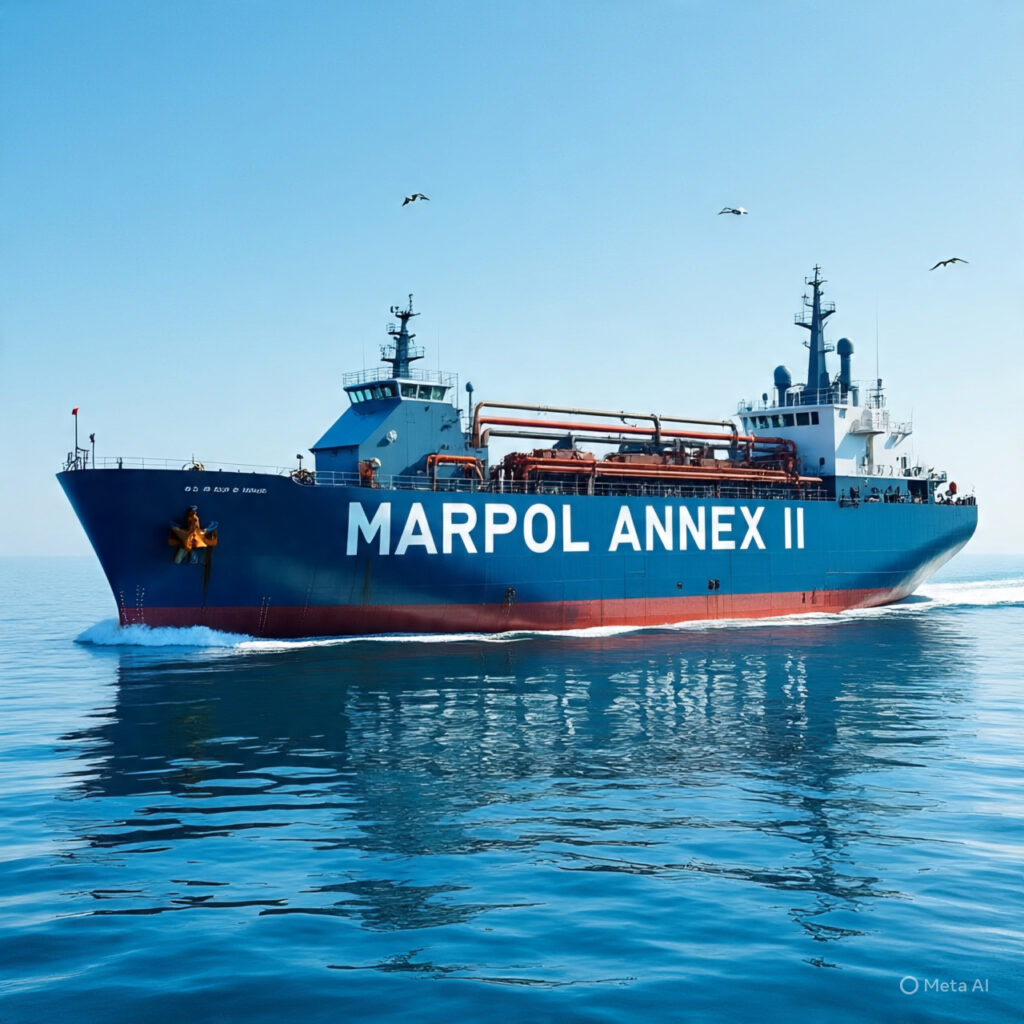
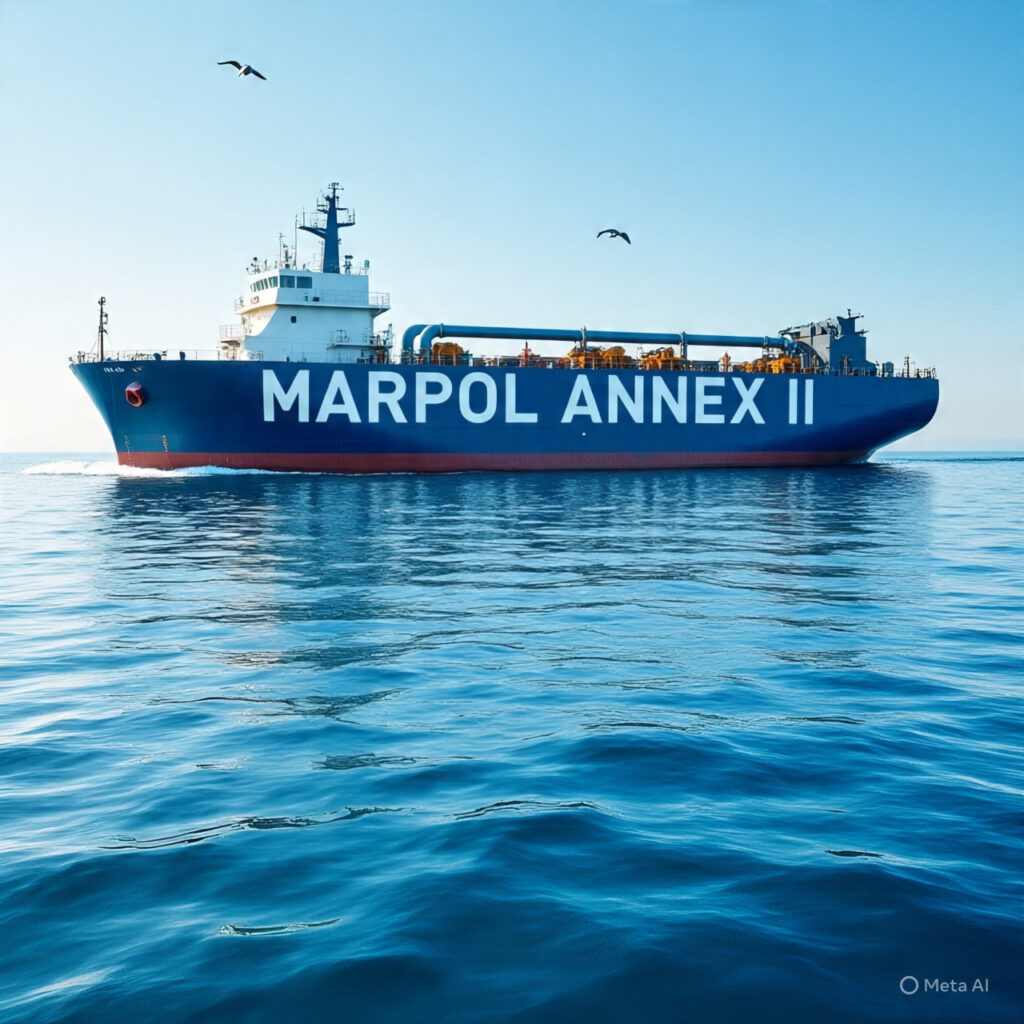
When people think about pollution from ships, they usually imagine oil spills. However, ships also transport thousands of harmful liquid chemicals, such as acids, solvents, and pesticides. If released, these substances can damage marine life, fisheries, and coastal communities. To control this risk, the International Maritime Organization (IMO) created MARPOL Annex II – Regulations for the Control of Pollution by Noxious Liquid Substances in Bulk.
In this article, we will explore what Annex II covers, how ships comply with it, and why it matters.
What is MARPOL Annex II?
Annex II entered into force in 1987 and remains one of the most important parts of MARPOL. It specifically regulates the discharge of noxious liquid substances (NLS) carried in bulk. The rules mainly apply to chemical tankers, but any ship carrying such cargo must comply. Ultimately, the goal is to minimize chemical pollution at sea.
Categories of Noxious Liquid Substances (NLS)
To make enforcement easier, Annex II divides harmful liquids into four categories based on the level of danger:
- Category X – These substances present a major hazard. Ships cannot discharge them into the sea under any circumstance.
- Category Y – These present a hazard. Discharge is allowed only under controlled and limited conditions.
- Category Z – These present a minor hazard. Discharge is possible with fewer restrictions but still under regulation.
- Other Substances (OS) – These pose no significant harm. Ships can discharge them more freely if they follow set conditions.
This clear categorization helps crews understand exactly how to handle different chemicals.
Discharge Rules Under Annex II
Ships must follow strict discharge rules when dealing with cargo residues and tank washings:
- For Category X substances, discharge is strictly prohibited. Instead, crews must clean the tanks and deliver residues to reception facilities ashore.
- For Category Y and Z substances, discharge is possible only if the ship is en route, outside Special Areas, and the substance passes through an approved underwater outlet.
- For Other Substances, discharge is allowed with fewer restrictions, but the ship must still follow operational rules.
Because of these requirements, ports must provide reception facilities so ships can dispose of residues safely.
Special Areas Under Annex II
At present, the Antarctic Area (south of latitude 60° S) is designated as a Special Area under Annex II. In this zone, ships cannot discharge any noxious liquid substances or tank washings. This complete ban highlights the fragile nature of the Antarctic ecosystem.
Ship Requirements Under Annex II
To comply with Annex II, ships must meet several technical and operational requirements:
1. Certificate of Fitness
Chemical tankers must hold a Certificate of Fitness. Surveyors issue it only after confirming that the ship meets design and safety standards.
2. Procedures and Arrangements (P&A) Manual
Every ship carrying NLS must carry an approved P&A Manual. It explains how the crew should load, unload, clean tanks, and handle residues. It also provides emergency instructions.
3. Cargo Tank Design
Depending on the cargo, tanks must be coated or built with stainless steel. Pumping and stripping systems must work efficiently so that tanks retain very little residue after unloading.
4. Cargo Residue Monitoring
Crews must check that tanks are stripped to the required standard. Proper monitoring ensures that only minimal residue remains inside.
Surveys and Certification
Ships undergo several surveys to prove compliance:
- Initial survey before entering service.
- Renewal survey every five years.
- Intermediate and annual surveys to confirm ongoing compliance.
After successful surveys, the ship receives the International Pollution Prevention Certificate for the Carriage of Noxious Liquid Substances in Bulk (NLS Certificate).
Why MARPOL Annex II is Important
MARPOL Annex II plays a vital role in protecting our oceans. By classifying chemicals into categories, enforcing discharge rules, and requiring ships to use reception facilities, it ensures that harmful substances do not freely enter the sea. Additionally, it promotes safer designs for chemical tankers and demands proper training for seafarers.
As a result, Annex II not only reduces chemical pollution but also raises global standards for the safe transport of hazardous cargo.
Challenges in Implementation
Although Annex II sets strong rules, practical challenges remain:
- Crews need specialized training to handle dangerous cargo safely.
- Many ports still lack affordable and efficient reception facilities.
- Tank cleaning can take significant time and money.
- Authorities find it difficult to monitor and prevent illegal discharges at sea.
Conclusion
MARPOL Annex II – Regulations for the Control of Pollution by Noxious Liquid Substances in Bulk provides a clear framework for handling chemical cargo safely. By banning discharges of the most dangerous substances, setting strict conditions for others, and requiring surveys and certification, Annex II helps protect marine ecosystems.
For seafarers, the key lessons are straightforward:
✅ Never discharge Category X substances.
✅ Follow the strict conditions for Category Y and Z.
✅ Always use reception facilities when required.
Through responsible operations, seafarers and shipowners can ensure that the transport of chemicals supports global trade without destroying the oceans we all depend on.
Pingback: MARPOL Annex IV: Prevention of Pollution by Sewage from Ships - Jhazi Bhaiya G
Pingback: MARPOL Annex III: Prevention of Pollution by Harmful Substances in Packaged Form - Jhazi Bhaiya G
Pingback: MARPOL Annex V: Prevention of Pollution by Garbage from Ships - Jhazi Bhaiya G
Pingback: Interview Tips For Merchant Navy - Jhazi Bhaiya G