
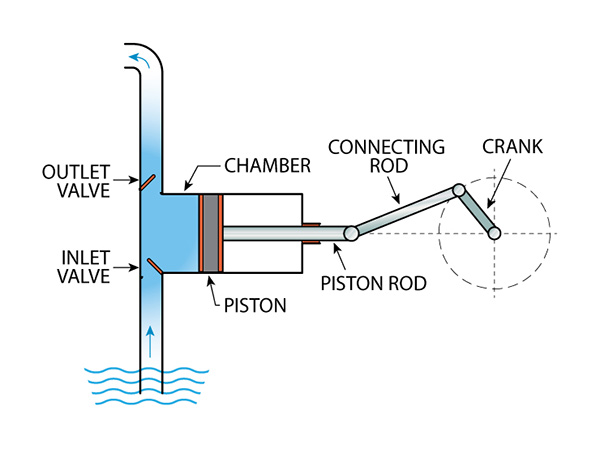
Reciprocating pumps are positive displacement pumps commonly used onboard ships where high pressure and accurate delivery of fluid are required. Unlike centrifugal pumps that rely on rotational force, a reciprocating pump operates by back-and-forth (reciprocating) motion of a piston or plunger inside a cylinder. This action draws liquid in during the suction stroke and pushes it out during the discharge stroke.
Because of their precise and powerful pumping action, reciprocating pumps are used in applications where reliable flow at high pressure is essential.
How Does a Reciprocating Pump Work? (Simple Explanation)
A reciprocating pump works in two main strokes:
1. Suction Stroke
- The piston moves backward.
- A vacuum is created inside the cylinder.
- The suction valve opens.
- Liquid enters the cylinder.
2. Discharge Stroke
- The piston moves forward.
- Pressure inside the cylinder increases.
- The discharge valve opens.
- Liquid is pushed out at high pressure.
This repeated forward and backward movement provides a constant, high-pressure flow even if the quantity per stroke is small.
Types of Reciprocating Pumps Onboard Ships
1. Simplex Pump
- Single cylinder.
- One suction and one discharge stroke per cycle.
- Used for small, precise pumping operations.
2. Duplex Pump
- Two cylinders operating 180° out of phase.
- Smoother flow compared to simplex.
- Reduces pulsation.
3. Power-Driven Reciprocating Pump
- Driven by electric motor or steam turbine.
- Used for high-pressure applications like boiler feed.
4. Hand-Operated Reciprocating Pump
- Used for emergency bilge pumping or small transfer tasks.
- Manually operated when power is unavailable.
Where Are Reciprocating Pumps Used Onboard?
Reciprocating pumps are used in areas where high pressure and accuracy matter more than flow rate. Common uses include:
✔ Boiler Feed Pumps
They deliver water to the boiler against high pressure.
✔ Hydraulic Systems
Provide pressure oil for steering gear and stabilizers.
✔ Fuel Injection and Transfer
Used in older systems requiring precise flow control.
✔ Lubrication Systems
Deliver lubricating oil under pressure to machinery.
✔ Emergency Bilge Pump
Hand-operated types used for emergency bilge pumping.
Advantages of Reciprocating Pumps
- Can generate very high pressure.
- Suitable for viscous liquids.
- Pumping rate is accurate and consistent.
- Self-priming capability.
- Can work efficiently even at small capacities.
Disadvantages
- Low flow rate compared to centrifugal pumps.
- Pulsating discharge unless duplex or multiplex.
- Many moving parts → more maintenance.
- Heavy and noisy operation.
Maintenance Tips
- Regularly check valves and seats for wear.
- Inspect piston rings and packing seals.
- Ensure lubrication of moving parts.
- Remove air locks for smooth operation.
- Monitor pressure gauges for abnormalities.
Conclusion
Reciprocating pumps remain essential onboard for tasks requiring high pressure, self-priming, and accurate fluid displacement. Although centrifugal pumps dominate general shipboard pumping, reciprocating pumps still play a critical role in areas such as boiler feed, hydraulic operations, and lubrication systems.
Disclaimer:This blog provides general marine engineering information for educational purposes. Procedures may vary by vessel, class rules, and manufacturer guidelines. Always follow your company’s SMS, equipment manuals, and safety instructions.