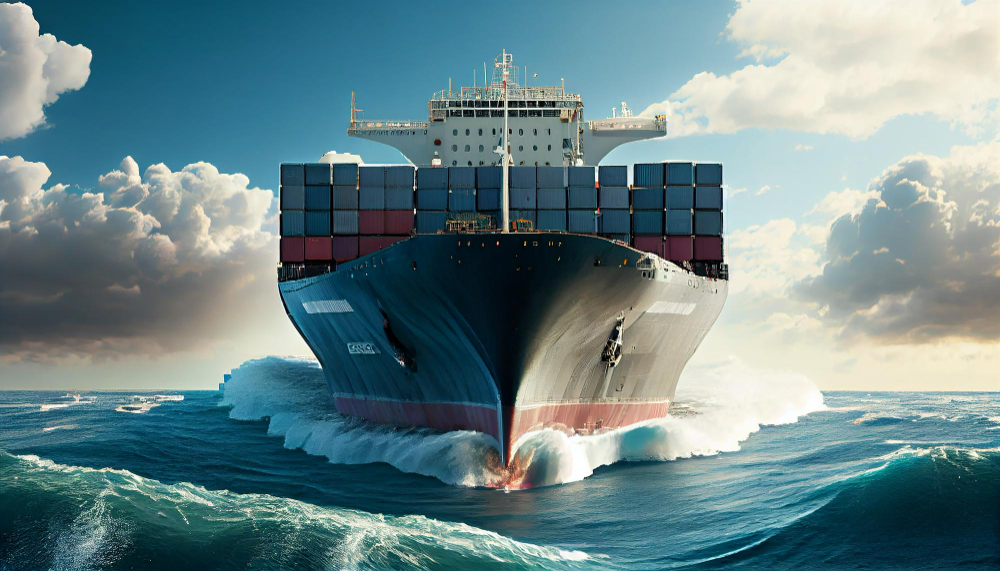
Fire is one of the most dangerous emergencies at sea. Onboard ships, engine rooms and cargo spaces contain large quantities of flammable fuel, oil, and electrical systems that can quickly turn a minor fire into a major disaster. To combat such high-risk fires, vessels are equipped with a Fixed CO₂ System onboard ship, a critical part of the ship’s total firefighting arrangement. As per SOLAS Chapter II-2 and the FSS Code, this system is mandatory for all machinery and cargo spaces where fire hazards are significant.
🔥 What is a Fixed CO₂ System?
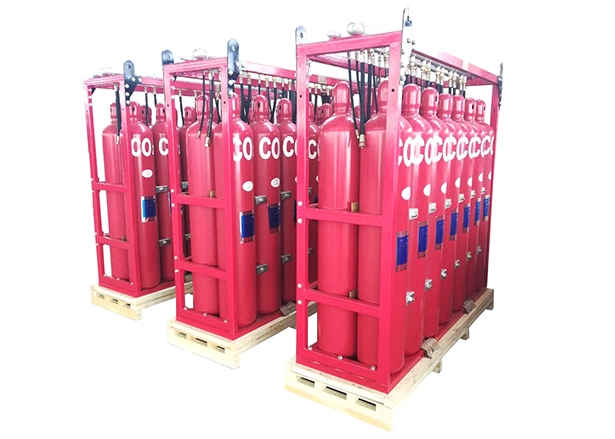
A Fixed CO₂ System Onboard Ship is an automatic or manually operated fire suppression system designed to flood a protected space with carbon dioxide gas. The system uses CO₂ stored in high-pressure cylinders, which, when released, replaces oxygen in the compartment and extinguishes the fire by smothering it.
Because CO₂ is non-corrosive and leaves no residue, it is ideal for machinery spaces, engine control rooms, and cargo holds where equipment cleanliness is essential.
⚙️ Working Principle of the Fixed CO₂ System
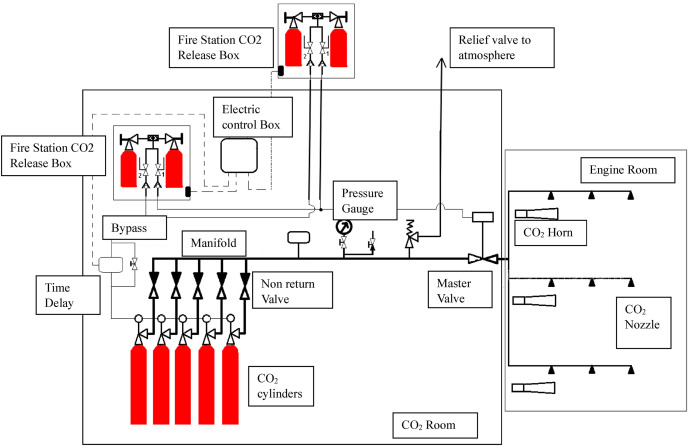
The fixed CO₂ system works on the principle of oxygen displacement.
- Detection and Activation:
A fire is detected in the machinery or cargo space. The crew activates the system manually or through a remote control station. - Release of CO₂:
Upon activation, CO₂ from storage cylinders is released into a manifold and distributed through a piping network to nozzles in the protected area. - Fire Suppression:
The CO₂ gas rapidly fills the space, reducing oxygen concentration below 15%, which prevents combustion and extinguishes the fire. - Post-Fire Actions:
The space remains sealed to prevent re-ignition, and ventilation is restarted only after ensuring it is safe for entry.
🧯 Components of a Fixed CO₂ System
A complete system includes the following major components:
- CO₂ storage cylinders (high-pressure type)
- Manifold and distribution piping
- Non-return and release valves
- Manual and remote release controls
- Time delay device and alarms
- Pressure relief valves
- Diffusing nozzles in protected areas
The number of CO₂ cylinders is calculated based on the volume of the protected space and the required gas concentration for effective extinguishing.
⚠️ Safety Features and Alarms
Because CO₂ is a suffocating gas, the system includes several built-in safety measures:
- Pre-discharge alarm: Audible and visual alarm before CO₂ release
- Time delay unit: Allows crew evacuation before gas discharge
- Lockable release box: Prevents accidental activation
- Warning signage: Posted outside all protected compartments
- Post-discharge ventilation procedures: To avoid suffocation hazards
Crew training and safety drills are essential for ensuring everyone knows how to respond during an emergency release.
📜 SOLAS and FSS Code Requirements
According to SOLAS Chapter II-2, Regulation 10 and the FSS Code, every ship must:
- Have a fixed CO₂ system for machinery spaces and cargo holds where fire risk exists
- Ensure the total CO₂ quantity is sufficient to achieve minimum 35% gas concentration in the protected space
- Install the system so that the release controls are located outside the protected space
- Conduct annual inspections and 5-year testing of cylinders and valves
- Maintain a safety release procedure and crew training records
Port State Control and Class Surveyors verify system functionality and documentation during safety audits.
🔧 Testing and Maintenance
| Inspection Item | Frequency | Description |
|---|---|---|
| System visual inspection | Monthly | Check cylinders, gauges, and signage |
| Weight and pressure check | Annually | Verify CO₂ cylinder quantity and pressure |
| Alarm and time delay test | Annually | Ensure proper operation |
| Cylinder hydrostatic testing | Every 10 years | As per SOLAS and class rules |
| Line and nozzle inspection | Periodically | Ensure no obstruction or corrosion |
All findings must be logged in the Fire Safety Maintenance Record.
🚢 Advantages of Fixed CO₂ System Onboard Ship
- Rapid and effective extinguishing of machinery and cargo fires
- No residue left after discharge
- Minimal damage to equipment
- Requires no cleanup after activation
- Reliable even in unattended engine rooms
However, crew safety remains the top priority, as CO₂ can cause suffocation if used improperly.
⚠️ Precautions During CO₂ Release
- Confirm complete evacuation of the protected area
- Sound alarm before discharge
- Close all ventilation flaps, doors, and dampers
- Do not enter the space until verified safe with gas detection equipment
Following procedures as per the Safety Management System (SMS) ensures safe operation.
✅ Conclusion
The Fixed CO₂ System Onboard Ship is a crucial part of marine firefighting equipment that ensures rapid and reliable fire suppression in high-risk areas. Its effectiveness, speed, and residue-free nature make it indispensable for modern ships. However, correct operation, timely maintenance, and proper crew training are vital to guarantee safety and compliance with SOLAS standards. When handled correctly, this system can be the difference between saving and losing a ship.
⚠️ Disclaimer:This article is for educational and general awareness purposes. While the information aligns with SOLAS and FSS Code requirements, actual arrangements and maintenance schedules may vary depending on ship type, flag state, and classification society. Always refer to the vessel’s Safety Management System (SMS) and manufacturer manuals for accurate procedures.