
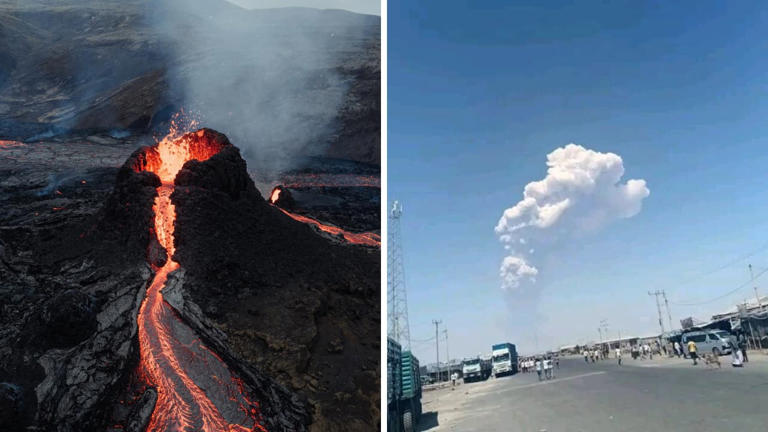
On 23 November 2025, the world witnessed a rare natural event. A long-dormant volcano in northern Ethiopia suddenly came back to life after nearly 12,000 years. This unexpected Ethiopian Volcano Eruption involved Hayli Gubbi, a remote peak located in the dry Afar Region. The volcano sits within the famous Erta Ale volcanic chain.
The eruption surprised scientists, local residents, and global observers. Until now, no one had documented any Holocene-era eruption from Hayli Gubbi. In simple terms, the volcano had shown no known activity since the end of the last Ice Age.
What Happened During the Eruption
The eruption began in the morning and quickly intensified. Ash, smoke, and gases rose high into the sky. Thick plumes drifted across nearby villages, and the explosion created a loud shockwave. Although the area is sparsely populated, residents still felt the impact. Many described the eruption as sudden and extremely powerful.
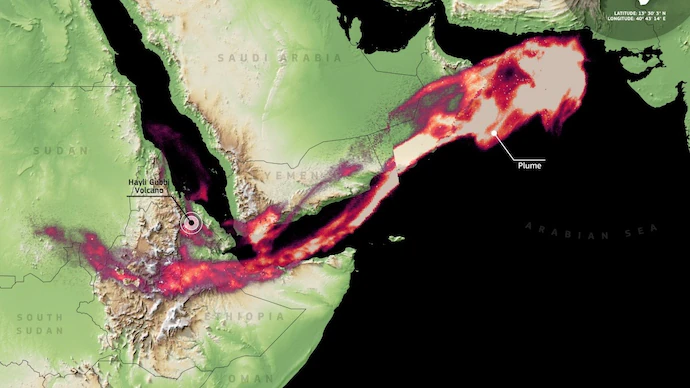
Within hours, satellite images captured the ash cloud spreading over the region. The plume climbed several kilometers into the atmosphere and moved eastward with strong winds.
Local Impact on Communities and Environment
Despite the dramatic scene, authorities reported no casualties. However, the eruption still affected daily life. Ash covered grazing lands and reduced visibility. Consequently, herders started worrying about their animals, as livestock depend heavily on clean grass and water.
Furthermore, the ash may contaminate water sources. It may also reduce soil quality, which raises long-term concerns for the pastoral communities that rely on the land.
Regional and International Effects
The eruption did not stay confined to Ethiopia. Strong winds carried the ash across the Red Sea and toward parts of the Arabian Peninsula. As a result, aviation authorities issued safety advisories. Several flights were delayed or rerouted to avoid ash clouds, which can damage aircraft engines.
Additionally, the drifting ash affected air quality in downwind regions. Some areas experienced hazy skies and unusual sunsets. While these effects were temporary, authorities continued to monitor the situation.
Why This Eruption Matters Scientifically
This event holds major importance in the scientific community. First, Hayli Gubbi was considered dormant. Now, the eruption shows that even ancient and quiet volcanoes can reactivate.
Secondly, the Afar Region lies in the East African Rift System, one of the most active tectonic zones on Earth. The eruption highlights the intense geological processes occurring deep below the surface.
Finally, researchers now have a chance to study a once-inactive volcano. This will help them refine hazard maps and improve early-warning systems in similar volcanic zones.
What Comes Next
Going forward, scientists will continue monitoring Hayli Gubbi. Local communities will also need support to recover grazing lands and ensure clean water. Meanwhile, aviation and weather agencies will track any remaining ash in the atmosphere.
Although the eruption has settled, the event reminds us that Earth remains dynamic and unpredictable. A volcano silent for 12,000 years can still awaken without warning.
🇮🇳 Impact on India from the Ethiopian Volcano Eruption
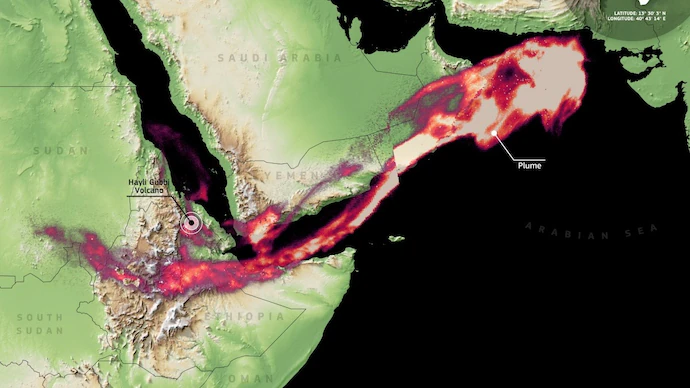
- The ash plume from Hayli Gubbi drifted thousands of kilometres and reached parts of northwestern and northern India — including regions such as Gujarat, Rajasthan, Delhi-NCR, Punjab and Haryana — carried by high-altitude winds. The Times of India+2www.ndtv.com+2
- As a result, aviation authorities in India — especially DGCA (Directorate General of Civil Aviation) — issued urgent advisories. Several airlines cancelled or rerouted flights to avoid ash-affected airspace.
- Because the ash cloud remained mostly high in the upper atmosphere (roughly 10–15 km altitude), surface-level impacts — like worsened air quality or weather disruption — remained unlikely over most of India.
- Nevertheless, meteorological agencies and health experts warned that the volcanic ash contains fine rock and glass particles plus sulphur dioxide. If it were to descend or mix with surface air — even partially — it could irritate lungs, especially for people with asthma or respiratory problems.
- For a short while, the skies over some regions looked hazier or more opaque than usual; some passengers experienced flight delays and cancellations. The event served as a reminder of how distant geological events can ripple across regions via wind and air-space.
Conclusion
The Ethiopian Volcano Eruption of Hayli Gubbi is a rare and powerful reminder of nature’s force. A mountain forgotten for millennia suddenly changed landscapes, disrupted travel, and captured global attention. As scientists analyze what triggered this eruption, the world continues to learn how living on a geologically active planet requires constant awareness and preparedness.
✅ Disclaimer:This article is based on currently available information from news agencies, scientific updates, and regional reports. Details may evolve as authorities release new data. Readers should verify critical information through official government and scientific sources. The author and publisher are not responsible for any decisions made based on the content of this blog.