Fresh water is one of the most critical requirements on any vessel. Ships need fresh water for drinking, cooking, cleaning, machinery cooling, and boiler operation. Since carrying large amounts of water is impractical, ships produce their own using a Fresh Water Generator (FWG).
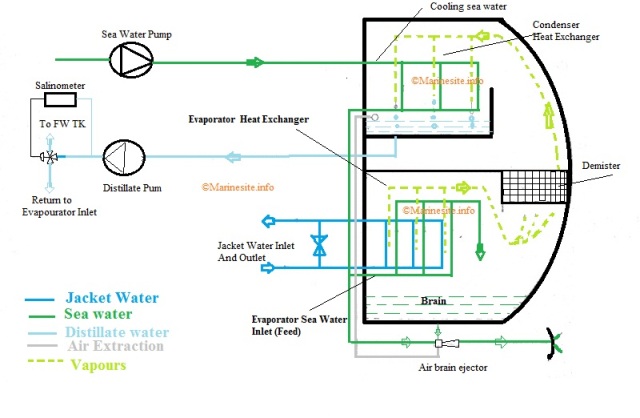
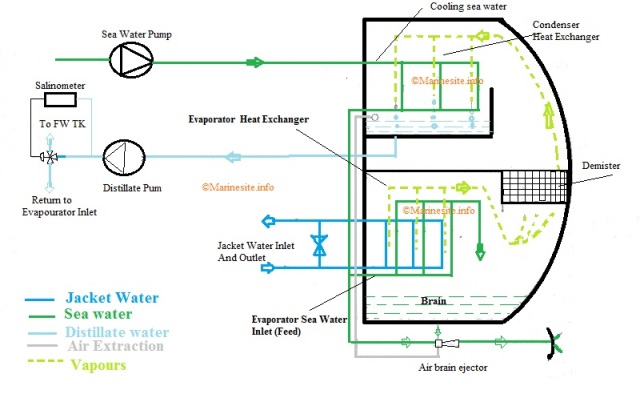
The sketch provided shows a Low-Pressure (LP) Evaporator Type Fresh Water Generator, the most common system on marine vessels. This type of FWG uses engine jacket cooling water as the heat source and seawater as the feed. The system operates under vacuum, allowing seawater to boil and evaporate at low temperatures.
🔧 Components (As Seen in the Image)
- Evaporator Chamber (right side of diagram)
- Heater Tubes / Plates
- Condenser Tubes
- Demister Pad
- Vacuum Ejector
- Brine Overboard Line
- Seawater Feed Line
- Condenser Cooling Seawater Inlet & Outlet
- Fresh Water Pump (clearly marked in the image)
- Jacket Cooling Water Inlet & Outlet
🌊 How the Fresh Water Generator Works (Step-by-Step Based on the Sketch)
1. Seawater Feed Into the Evaporator
The process begins with seawater entering from the main line, controlled by valves shown in the diagram.
This seawater moves into the evaporator section, forming a thin film over the heated plates.
This step is crucial because a thin film evaporates faster under vacuum.
2. Heating Using Engine Jacket Cooling Water
The evaporator receives hot jacket cooling water (approximately 70–80°C) from the main engine.
This hot cooling water circulates inside the heater tubes/plates shown in the right-hand chamber of the sketch.
Because the FWG is under vacuum, seawater begins evaporating at 50–60°C.
3. Vacuum Creation by the Ejector
The vacuum ejector (indicated at the bottom-right of your image) uses a jet of seawater to remove air and gases from the chamber.
This keeps the evaporator at 85–95% vacuum, lowering the boiling point of seawater.
A stable vacuum ensures faster evaporation and higher efficiency.
4. Formation of Vapour
As seawater heats, it turns into fresh water vapour.
The vapour rises upward through the internal vapor path into the condenser section.
Before entering the condenser, vapour passes through demister pads, which catch water droplets and prevent salt carryover.
5. Condensation in the Condenser Tubes
The upper section of the sketch shows the condenser.
Here, cold seawater flows through condenser tubes, cooling the vapour.
The vapour condenses into pure fresh water, collecting at the bottom of the condenser tray.
This is the clean, distilled water that becomes usable onboard.
6. Fresh Water Pump Operation
In your sketch, the Fresh Water Pump is clearly marked.
This pump extracts the distilled water from the condenser and transfers it to:
- Fresh water tank
- Mineraliser (to add minerals)
- Boiler feed system
A non-return valve prevents backflow into the FWG.
The fresh water pump is one of the most important moving parts in the system.
7. Brine Discharge
The leftover concentrated seawater (brine) is continuously removed from the evaporator.
A brine line and ejector discharge it overboard after the salts become too concentrated.
Maintaining proper brine flow prevents scale formation inside the evaporator chamber.
🔁 Full Flow Summary Based on the Sketch
Heating Side (Evaporator):
- Jacket cooling water IN → heat transfer → OUT.
Cooling Side (Condenser):
- Cold seawater IN → absorbs heat → OUT.
Process Path:
- Seawater feed enters evaporator
- Heated by jacket cooling water
- Vapour rises
- Demister removes droplets
- Vapor enters condenser
- Cold seawater condenses vapour
- Fresh water collects → pumped out
- Brine discharged overboard
⚓ Advantages of the System
- Uses waste heat from engine → no extra fuel needed
- Produces 10–30 tons of fresh water per day (varies by size)
- Low maintenance system
- Compact and reliable
🔧 Common Problems
- Low vacuum → poor evaporation
- Scaling on heater plates
- Low seawater flow in condenser
- Fresh water pump failure
- Leaks in demister or tubes causing contamination
🧭 Conclusion
The Fresh Water Generator shown in your sketch is a highly efficient, low-pressure evaporator system that uses engine heat and seawater to produce fresh water for daily shipboard operations. Understanding its flow path helps engineers operate and troubleshoot the system effectively.
Disclaimer:This blog provides general information for learning and awareness. It does not replace official manuals, professional training, or manufacturer instructions. Always follow your company’s safety procedures and approved guidelines when operating or maintaining ship machinery.