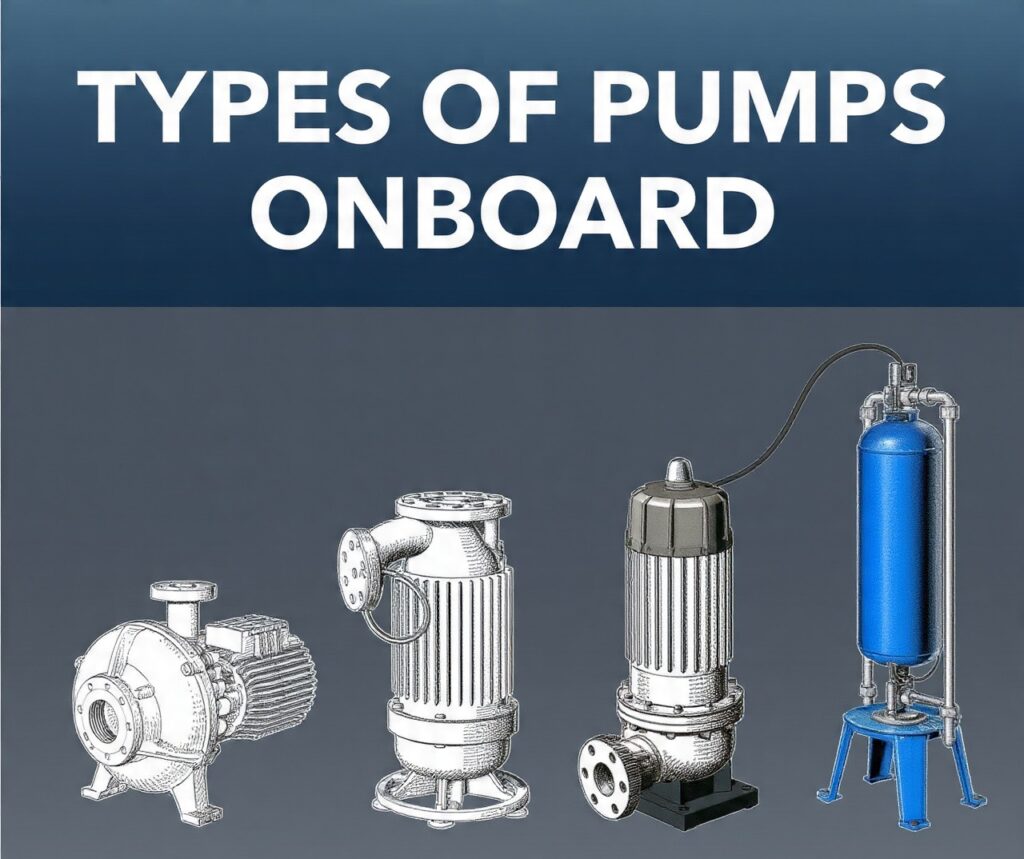
Pumps are essential pieces of machinery used onboard ships for almost every operation involving liquid transfer. When we talk about the Types of Pumps Onboard, we refer to the different categories of pumps that help move seawater, fuel, lube oil, freshwater, sludge, and even cargo. Since ships operate continuously at sea, these pumps must work reliably to ensure the vessel’s safety and efficiency. In this blog, we explore all major types of pumps used onboard, along with their working principles and applications.
Why Pumps Are Important Onboard Ships
Pumps play a key role in:
- Cooling engines
- Handling fuel and lube oil
- Fighting fires
- Discharging bilge and ballast
- Managing sewage systems
- Pumping cargo on tankers
Because ships carry different fluids under varying pressures and temperatures, several types of pumps are required, each designed for a specific task.
1. Positive Displacement Pumps (PDP)
Positive displacement pumps move a fixed amount of liquid by trapping and pushing it through a chamber. They offer constant flow regardless of pressure changes, making them ideal for viscous fluids like heavy fuel oil.
Positive displacement pumps are divided into Reciprocating and Rotary types.
A. Reciprocating Pumps
These pumps use a back-and-forth motion to move liquid. They deliver high pressure and accurate flow.
1. Piston Pump
- Moves liquid using a piston inside a cylinder
- Used for older boiler feed systems
- Produces high discharge pressure
2. Plunger Pump
- Similar to piston pumps but uses a plunger
- Provides even higher pressure
- Used in hydraulic systems, pressure cleaning
3. Diaphragm Pump
- Uses a flexible diaphragm
- No leakage
- Ideal for chemicals, toxic liquids, sludge, and sewage
B. Rotary Pumps
Rotary pumps use rotating elements to move liquids. They offer smooth, steady flow and can handle viscous fluids.
1. Gear Pump
- Two gears rotate to push liquid
- Commonly used for fuel oil and lube oil systems
- Simple and reliable
2. Screw Pump
- One, two, or three screws rotate to push liquid forward
- Excellent for heavy and viscous liquids
- Commonly used in HFO systems, booster modules, lube oil systems
3. Vane Pump
- Has a rotor with sliding vanes
- Used in hydraulic systems
- Self-priming and efficient
4. Lobe Pump
- Two lobes rotate without touching
- Can handle solids
- Used for sludge transfer and food cargo
2. Dynamic Pumps
Dynamic pumps use kinetic energy and centrifugal force to move liquids. They are the most commonly used pumps on ships.
A. Centrifugal Pumps
These pumps use a rotating impeller that creates pressure by pushing liquid outward.
Types of Centrifugal Pumps
1. Single-Stage Pump
- One impeller
- Used for cooling water, bilge, ballast systems
2. Multi-Stage Pump
- Multiple impellers increase pressure
- Used for boiler feed water and high-pressure systems
3. Submersible Pump
- Works underwater
- Used in cargo holds, emergency dewatering
4. Deepwell Pump
- Installed vertically with a long shaft
- Common on tankers for cargo discharge
5. Vertical Turbine Pump
- Multi-stage pump mounted vertically
- Used for seawater lift systems
3. Special Marine Pumps and Their Uses
Ships carry many specialized pumps for daily and emergency operations.
A. Bilge Pump
- Removes dirty water from bilges
- Can be centrifugal or reciprocating
B. Ballast Pump
- Moves seawater in/out of ballast tanks
- Always centrifugal
C. Fire Pump
- Supplies seawater for firefighting
- Must meet SOLAS & FSS Code requirements
D. Emergency Fire Pump
- Located outside engine room
- Used when main fire pump fails
E. Fuel Oil Transfer Pump
- Moves fuel from storage to service tanks
- Screw or gear type
F. Fuel Oil Booster Pump
- Supplies high-pressure fuel to main engine
- Typically screw pump
G. Lube Oil Pump
- Provides lubrication to machinery
- Gear or screw type
H. Fresh Water Pump
- Supplies drinking and domestic water
- Centrifugal pump
I. Sewage Pump
- Moves sewage to treatment plant or holding tank
- Diaphragm or vortex pump
J. Hydrophore Pump
- Maintains accommodation water pressure
- Works with hydrophore tank for smooth water supply
K. Cargo Pumps (for tankers)
- Deepwell, screw, or centrifugal
- Handles crude oil, chemicals, and petroleum products
Difference Between Centrifugal and Positive Displacement Pumps
| Feature | Centrifugal Pump | Positive Displacement Pump |
|---|---|---|
| Flow | Varies with pressure | Constant flow |
| Fluids | Best for thin liquids | Best for viscous liquids |
| Priming | Not self-priming | Usually self-priming |
| Pressure | Low to medium | High |
| Common Use | Bilge, ballast, cooling | Fuel, lube oil, chemicals |
Conclusion
Pumps are the backbone of ship operations, supporting everything from firefighting to fuel handling. Understanding their types, working principles, and applications is essential for cadets, marine engineers, and anyone preparing for maritime exams. With proper maintenance and operation, these pumps ensure a ship remains safe, efficient, and seaworthy throughout its voyage.
Disclaimer
This blog provides general information on pumps used onboard ships for educational and reference purposes. It should not be treated as a substitute for official maritime regulations, manufacturer manuals, or professional engineering guidance. Always follow your company’s safety procedures, class rules, and SOLAS/FSS Code requirements when operating or maintaining machinery onboard.